





Behind the Scenes at the S.E.E.D.S. Event
— A Front-Row Look at the Cutting Edge of Security in the Age of AI —
|
|
.png)
At Ashisuto, we are expanding beyond our core business to explore cutting-edge technologies and create new solutions to the challenges our customers face. At the core of these efforts is the “Innovation & Market Co-Creation Lab” (hereafter, “iLab”).
As the use of generative AI and AI agents rapidly accelerates, companies are gaining major opportunities to boost productivity. At the same time, they are also confronting new risks, including privilege escalation, information leaks, erroneous decisions, audit-trail management issues, and increasingly sophisticated cyberattacks that abuse AI. In light of this situation, iLab held its 8th community event on the theme of “Security in the Age of AI,” based on the latest research.
For this event, our PR team went behind the scenes to bring you a firsthand account. In addition to a look at what happened on the day, we will share iLab’s perspective on security in the AI era and introduce some of the latest technologies to watch.
1. iLab: An Organization That Explores Technology from a Neutral, Independent Standpoint
In January 2026, Ashisuto reorganized and relaunched its innovation division as iLab. Its mission is to discover unknown technologies from around the world and drive meaningful change to the businesses of customers in Japan. iLab's fundamental approach is to evaluate technologies from a purely neutral perspective—asking whether a technology is genuinely excellent on its own merits—unconstrained by any particular vendor or geopolitical considerations.
iLab's activities fall into four main areas: ① Research, discovery, and commercialization of advanced technologies; ② Proposals, validation, and implementation support for forward-thinking enterprises; ③ Support for overseas startups entering the Japanese market; and
④ the S.E.E.D.S.*¹ community, which serves as the connective hub for all of the above.
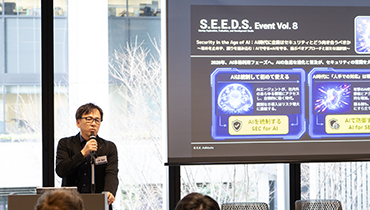
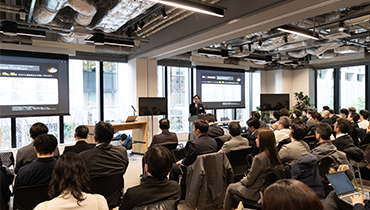
In this community, user companies, overseas startups, and Ashisuto come together to conduct technical validations and run co-creation programs. For the eighth edition, held under the theme “How should companies address security in the age of AI?”, 54 participants responsible for security and digital transformation (DX) at their respective organizations took part. Let’s look back at the discussions that took place on the day.
|
Ashisuto |
|
- ※1 Learn about the origins of S.E.E.D.S. here: https://www.ashisuto.co.jp/pr_blog/article/seeds202308.html
2. The Reality of AI Security, as Shared at the Event
The event opened with a candid look at the harsh realities facing today's security frontlines.
|
Ashisuto |
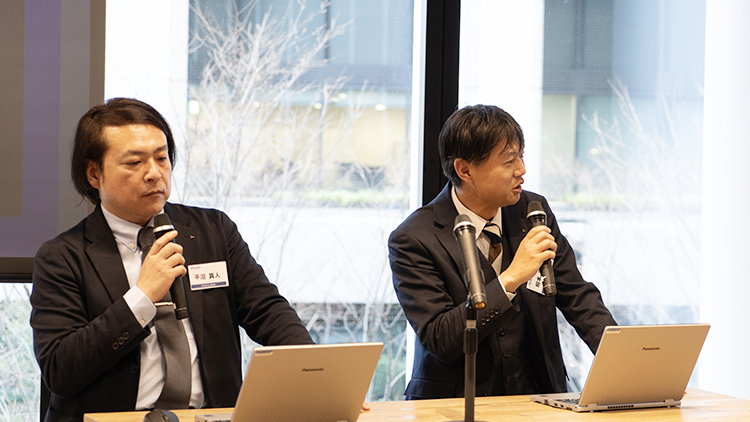
In the past, many phishing emails could be spotted thanks to their unnatural Japanese. But with the advent of generative AI, phishing emails now arrive in smooth, natural-sounding Japanese, making them increasingly difficult to detect. Moreover, AI has made it possible to create malware without advanced programming knowledge—there have even been reported cases in Japan of high school students with no programming experience developing malware using AI. The barrier to launching cyberattacks is unquestionably getting lower.
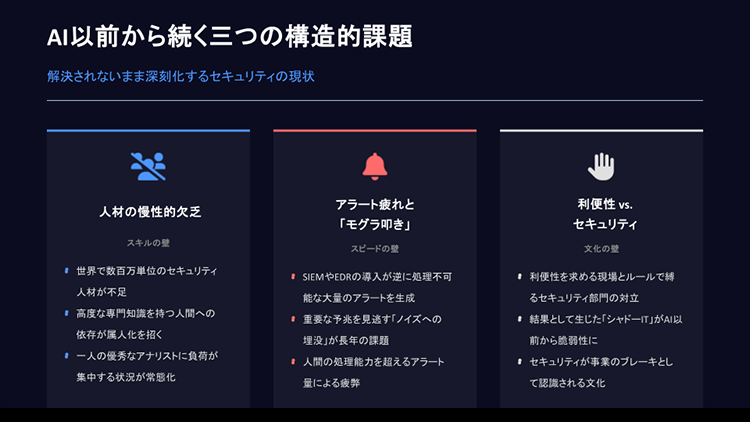
Meanwhile, what does the situation look like on the defensive side? Tens of thousands of alerts are generated every day, and investigating a single alert takes an average of over one hour. At the same time, attackers using AI can complete an intrusion in less than an hour. In other words, the reality is that today's operations, which rely on human effort, are structurally unable to keep pace in terms of response speed.
On top of this, new threats are expanding—such as "Shadow AI," where AI tools are adopted independently within organizations without proper oversight, and prompt injection*², which targets the behavior of AI systems themselves. While adoption advances driven by the appeal of convenience, governance struggles to keep up—this is precisely the structural dilemma many enterprises face today.
|
|
-
※2 A cyberattack that manipulates a generative AI system—especially an LLM—through externally supplied instructions, causing it to deviate from its intended constraints or behavior.
3.iLab's Approach to Security in the Age of AI
To address these challenges, iLab organizes its thinking around two axes.
The first is "AI for Security"—strengthening security through AI. This approach directly tackles structural challenges such as talent shortages and response speed limitations by leveraging AI. AI agents analyze massive volumes of alerts, prioritize them by urgency, and automate remediation. This extends to areas such as vulnerability detection and remediation, as well as the automation and autonomous management of increasingly complex identity management operations.
The second is "Security for AI"—protecting AI itself. This approach involves gaining centralized visibility into which systems and data AI agents and NHIs*³ are attempting to access, and blocking any suspicious access or risky behavior. This encompasses areas such as identifying Shadow AI, defending against prompt injection attacks that extract information through AI inputs, and establishing guardrails to prevent AI from responding with information it should not disclose—addressing the new risks that arise alongside AI adoption.
|
|
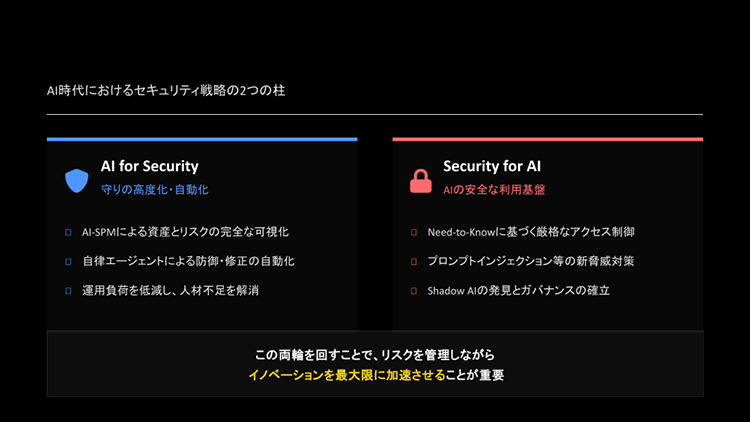
It is becoming critical to reframe security efforts and AI adoption as a source of external trust—shifting from merely "defending against threats" to "investing in a proactive foundation that builds trusted business relationships and drives growth."
|
|
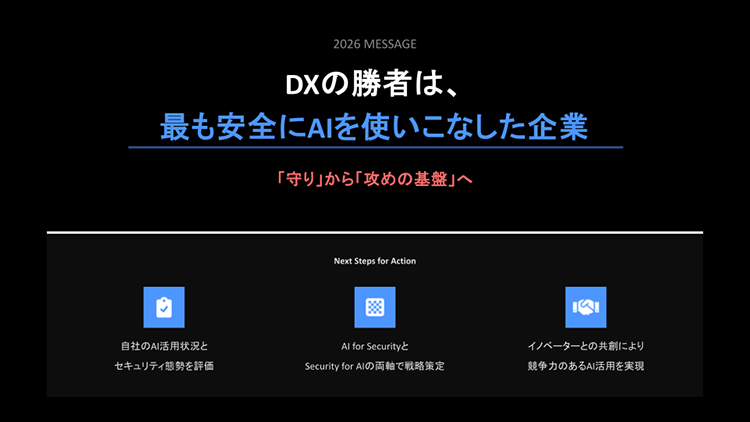
iLab is working alongside overseas startups and customers to bring this shift in mindset to life in real-world settings.With this framework in mind, iLab invited six companies whose approaches align with these two axes to present at the event.
-
※3 NHI: Non-Human Identity
4. Six Noteworthy Startups Leading the Global Frontier
This section provides a brief overview of each company's solution as presented at the event.
■ AI for Security
Simbian
A platform where AI agents autonomously handle Security Operations Center (SOC) tasks. It automates the entire workflow from alert triage to investigation and response, addressing the structural challenge of "being outpaced by attackers." Simbian is gaining attention as an immediate force multiplier—filling gaps during overnight hours and compensating for staffing shortages when 24/7 coverage is difficult.
Twine Security
A solution that deploys AI agents specializing in identity management as "digital employees." From account provisioning to permission assignment and periodic reviews, the AI autonomously executes identity management tasks that tend to become person-dependent—while incorporating human approval at key steps. It also supports a design where permissions are granted gradually, much like onboarding a new hire.
Cequence Security
A next-generation platform that protects the APIs underpinning modern systems. In an era where not only humans but also AI agents frequently interact with APIs, Cequence provides unified management—from API endpoint discovery to protection and monitoring.
|
Simbian |
Twine Security |
Cequence Security |


■ Security for AI
Zenity
Zenity is the AI security and governance platform that enforces how agents behave, what they access, and which tools they invoke across the modern environment. It unifies observability, posture management, as well as runtime threat detection and prevention to stop malicious actions before they execute.
Knostic
An agentic AI security platform that provides visibility into Shadow AI and AI agents (such as Cursor, GitHub Copilot, and Claude Code/Cowork), controls their behavior in real time to prevent operational incidents (like deleted hard drives or dropped databases), and secures the agentic supply chain (MCP servers, skills, plugins, hooks, and extensions).
Island
An enterprise browser that redefines the browser as a corporate security foundation. It enables granular governance at the browser level—where the vast majority of work takes place—including visibility into what is entered into AI tools and controls over copying sensitive data. Its distinguishing feature is implementing zero-trust principles at the browser layer rather than the network layer.
|
Zenity |
Knostic |
Island |
.png)


What all six companies share is a mindset that encompasses both sides of AI—"offense" (delegating tasks previously handled by humans to AI) and "defense" (confronting the new risks created by AI adoption).
No single solution addresses everything. It is important to consider the right combination based on your organization's specific challenges. iLab is currently working with customers to conduct technology evaluations and proof-of-concept (PoC)*⁴ trials for these solutions.
- ※4 iLab is currently conducting technology evaluations and PoC trials with customers for each of the solutions introduced above. This does not constitute a commitment to formal domestic distribution at this time. However, if you are a partner interested in jointly exploring the potential of cutting-edge technology, please do not hesitate to reach out.
5. The Energy of the S.E.E.D.S. Community
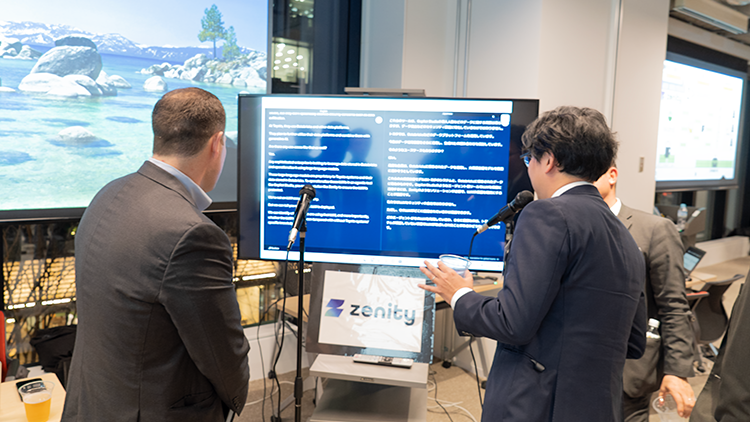
After the solution presentations, the networking session saw energy levels rise even further. Demo booths from each vendor were constantly surrounded by crowds, with lively Q&A sessions continuing as participants viewed live operational screens.
|
|
|
|
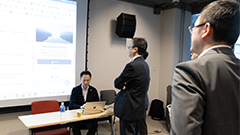
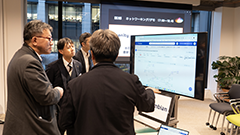

A notable addition this time was the introduction of real-time voice translation and subtitle tools at the booths. Even participants who were not comfortable in English could engage in direct, lag-free discussions with representatives from overseas startups. By using technology to remove the "language barrier," the event fostered more active dialogue than ever before.
|
|
We also received wonderful feedback from participants!
■Participant Comments
"It's incredibly valuable to get direct access to real, frontline information from overseas—not just domestic technologies!"
"This is a great forum for sharing real-world challenges with security and DX leaders from other companies."
"I'm not fully comfortable in English, so being able to chat in Japanese was great."
The conversations continued uninterrupted even during the reception, with Ashisuto employees, overseas vendor representatives, and customers interacting across business boundaries.
|
|
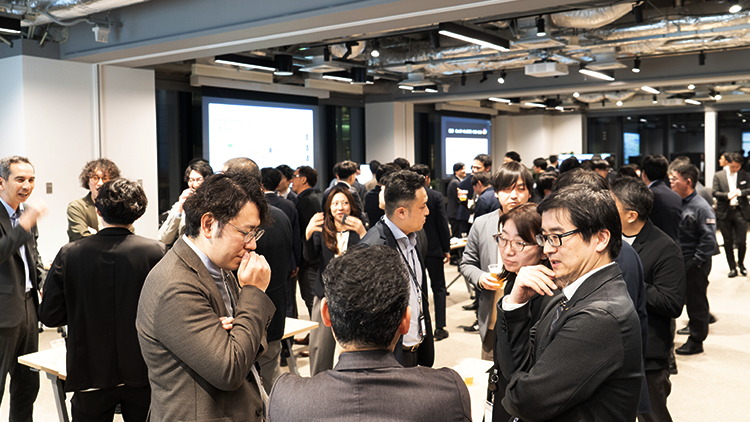
S.E.E.D.S. is more than just a venue for sharing information—it is a place where people connect and new seeds of business are born. That is the aspiration embedded in the name S.E.E.D.S.
|
|
|
|



6. Closing Remarks
Attending this event reinforced a key realization: security is no longer a layer you bolt on at the end—it must be built in from day one." S.E.E.D.S. Vol. 8 became a space where participants could share that reality together and think through what to do next.
Following this event, individual discussions have already begun with several participating companies. In the past as well, S.E.E.D.S. events have served as a starting point—going beyond mere information gathering to spark initiatives that explore how cutting-edge technologies can be applied to real-world business challenges. Through these efforts, this initiative is increasingly becoming a platform that encourages the adoption and utilization of advanced technologies among Japanese enterprises.
Going forward, S.E.E.D.S. will continue to provide practical forums for dialogue—bridging noteworthy technologies with real enterprise challenges across AI, data, and security.
Editor's Note / Norikata Katsuta
|
|
To be honest, before covering this event, I thought, "A security event… that sounds pretty tough." |